
1. Industrial Validation & Commissioning Tools
Online FAT & SAT Protocol Generator for industrial projects, equipment commissioning, factory acceptance testing, site acceptance testing, and technical validation.
This digital tool helps engineering, commissioning, quality, maintenance, and project teams create structured FAT and SAT test protocols, define acceptance criteria, record technical findings, evaluate test status, and generate an Excel-ready release report.
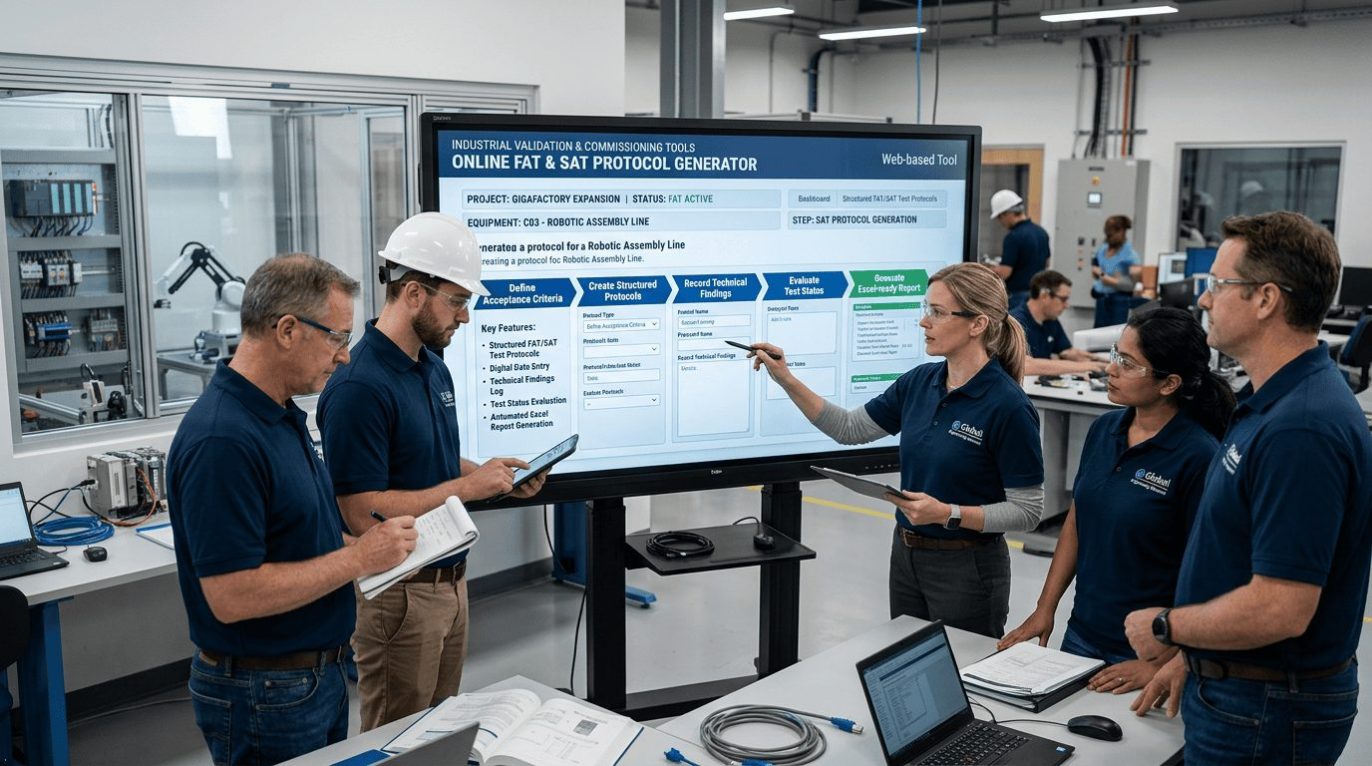
Dynamic FAT/SAT Protocol Optimizer and Generator with Infinite Findings Table and Excel Release Report Export (v2.0)
TODOPROYECTOS1.COM — INDUSTRIAL VALIDATION
DIGITAL FAT / SAT VALIDATION PROTOCOL GENERATOR SYSTEM (v2.2)
Commissioning Control, Design Qualification and Critical Equipment Release
2.0 Technical Test Record and Acceptance Criteria
| System / Component | Description of Evaluated Test or Acceptance Criterion | Technical Status | Comments / Deviations |
|---|---|---|---|
Quality Compliance Metrics
Official Commissioning Decision
Do you need all the tools?
Get access to the TodoProyectos1 Mega Pack, featuring the site’s templates, ebook, books, and professional resources—all in one package.
2. What Is the FAT & SAT Protocol Generator?
The FAT & SAT Protocol Generator is a digital tool designed to organize the technical validation of industrial equipment and systems before and after installation.
In an industrial project, equipment should not be considered ready simply because it has been manufactured or installed. The FAT and SAT processes provide structured checkpoints to verify that the equipment meets the required technical, functional, operational, and safety criteria.
The tool provides a practical digital workflow for documenting these tests and maintaining a traceable record of the validation process.
3. Factory Acceptance Test (FAT)
A Factory Acceptance Test (FAT) is normally performed at the manufacturer’s facility before the equipment is shipped to the project site.
The purpose is to verify that the equipment or system complies with the approved technical and functional requirements before transportation and installation.
Typical FAT Verification Areas
- General equipment functionality
- Operating sequences
- PLC and HMI systems
- Alarms and protections
- Interlocks
- Emergency stops
- Control logic
- Technical specifications
- Acceptance criteria
Performing these checks before shipment can help identify technical deviations while the equipment remains in a controlled environment.
4. Site Acceptance Test (SAT)
A Site Acceptance Test (SAT) is performed at the customer’s facility after the equipment has been installed and integrated into the industrial process.
Unlike FAT, SAT evaluates the equipment under actual site conditions and considers its interaction with electrical, mechanical, automation, utilities, production, and operating systems.
Typical SAT Verification Areas
- Equipment startup
- Continuous operation
- Integration with existing systems
- Electrical and mechanical interfaces
- Control system performance
- Response to abnormal conditions
- Production interaction
- Operator interaction
- Real operating conditions
5. FAT vs. SAT
| Aspect | FAT | SAT |
|---|---|---|
| Location | Manufacturer’s facility | Customer’s site |
| Timing | Before shipment | After installation |
| Environment | Controlled conditions | Actual operating conditions |
| Main objective | Validate equipment and design requirements | Validate site operation and system integration |
| Typical focus | Equipment functionality | Process and system integration |
FAT prevents problems before shipment. SAT confirms performance after installation.

6. What Can You Do With This Digital Tool?
The generator allows you to create and manage a structured FAT or SAT protocol directly from your browser.
General Audit Information
- Select the protocol type
- Enter the equipment or system name
- Enter the project code or ID
Technical Test and Acceptance Criteria
You can add multiple test or inspection requirements and record:
- System or component
- Test description
- Acceptance criterion
- Technical status
- Comments
- Deviations or findings
The structure is designed to function as a practical digital checklist for commissioning and equipment validation activities.
7. FAT & SAT Audit Metrics
Once the protocol has been completed, the tool analyzes the recorded criteria and provides a technical compliance overview.
The dashboard includes:
- Total audited criteria
- Final acceptance percentage
- Technical validation status
- Release condition
- Recorded findings and deviations
This allows the project team to quickly identify whether the protocol is ready for release or requires additional technical review.
8. Industrial Equipment Release Status
The validation workflow includes three practical outcomes:
- Full Release: The documented acceptance criteria have been satisfactorily completed.
- Conditional Release: The equipment may require specific pending actions, findings, or documented conditions.
- Validation Rejected: The recorded results do not meet the required acceptance conditions.
The final decision should always be supported by the project’s approved technical specifications, acceptance criteria, quality requirements, and responsible engineering authorities.
9. FAT & SAT Documentation
Documentation is one of the most important parts of equipment validation.
A test that is performed but not properly documented can create problems during commissioning, project closeout, quality audits, or future maintenance activities.
The FAT & SAT Generator includes an Excel-ready release report so that the recorded information can be transferred into a structured project document.
This provides a practical record of:
- Equipment identification
- Project identification
- Test criteria
- Acceptance status
- Technical comments
- Deviations
- Final validation status
10. FAT & SAT in Industrial Project Execution
FAT and SAT should not be treated as isolated checklists. They are part of the broader equipment commissioning, validation, quality, and project closeout process.
They can be connected with activities such as:
- URS — User Requirements Specification
- Equipment design review
- Commissioning
- Installation verification
- IQ / OQ / PQ activities
- MOC — Management of Change
- Technical documentation
- Project handover
A well-structured FAT/SAT process helps create traceability between what was specified, what was tested, what was found, and what was finally accepted.
11. Common FAT & SAT Problems
Several problems repeatedly appear during industrial equipment validation:
- Testing without clearly defined acceptance criteria
- Incomplete technical documentation
- Failure to involve operations personnel
- Uncontrolled changes during installation
- Insufficient testing under realistic conditions
- Failure to document deviations
- Closing the protocol without resolving critical findings
These issues can contribute to commissioning delays, rework, additional costs, and operational problems after project handover.
12. How to Use the FAT & SAT Protocol Generator
- Select FAT or SAT as the protocol type.
- Enter the equipment or system name.
- Enter the project code or identification number.
- Add each technical test or acceptance requirement.
- Enter the system or component being evaluated.
- Define the test or acceptance criterion.
- Select the technical status.
- Record comments, findings, or deviations.
- Run the protocol audit.
- Review the final acceptance percentage and validation status.
- Export the release report to Excel.
13. Practical Application in Industrial Projects
The tool can be applied to different types of industrial equipment and systems, including:
- Automation systems
- Electrical equipment
- Control panels
- Production machinery
- Pumping systems
- Process equipment
- Packaging equipment
- Industrial utilities
- Mechanical systems
- Integrated production lines
The exact acceptance criteria should always be adapted to the equipment specification, project requirements, applicable standards, and approved engineering documentation.
14. FAT & SAT Digital Validation Workflow
The complete workflow can be summarized as:
Requirements → Test Criteria → FAT → Shipment → Installation → Integration → SAT → Findings → Corrective Actions → Final Acceptance → Project Handover
This sequence creates a practical connection between engineering requirements and the final operational condition of the equipment.
15. FAT & SAT Generator 2026
The FAT & SAT Protocol Generator 2026 is designed for engineers, project managers, commissioning teams, quality engineers, maintenance professionals, automation engineers, contractors, and industrial operations teams who need a structured way to document equipment acceptance and validation.
Instead of managing FAT/SAT information across disconnected spreadsheets and handwritten checklists, the tool provides a centralized workflow for creating test criteria, recording technical results, evaluating acceptance, and generating an Excel-ready release report.
Use the digital FAT & SAT generator to structure your next equipment validation process.
Get access to the TodoProyectos1 Mega Pack, featuring the site’s templates, ebook, books, and professional resources—all in one package.
Frequently Asked Questions About FAT and SAT
What is FAT in an industrial project?
FAT stands for Factory Acceptance Test. It is performed at the manufacturer’s facility to verify that equipment meets the specified technical and functional requirements before shipment.
What is SAT in an industrial project?
SAT stands for Site Acceptance Test. It is performed at the customer’s facility after installation to verify equipment operation and integration under actual site conditions.
What is the difference between FAT and SAT?
FAT is performed before shipment in a controlled factory environment, while SAT is performed after installation at the project site under actual operating conditions.
Why are FAT and SAT important?
They provide structured opportunities to identify technical deviations, verify acceptance criteria, reduce commissioning risks, and document equipment performance before final project handover.
Can FAT and SAT be documented in Excel?
Yes. The digital generator includes an Excel-ready release report for documenting the protocol results and technical validation information.
Who should participate in FAT and SAT?
Depending on the project, participants may include engineering, project management, quality, commissioning, automation, maintenance, operations, suppliers, contractors, and equipment manufacturers.
Industrial Engineering Tool
FAT & SAT Protocol Generator — TodoProyectos1.com
A practical digital solution for equipment validation, commissioning, acceptance testing, technical documentation, and industrial project execution.
Get access to the TodoProyectos1 Mega Pack, featuring the site’s templates, ebook, books, and professional resources—all in one package.








Deja una respuesta